Medical Website Development: Complete Guide for 2026 (Features, Cost & Best Practices)
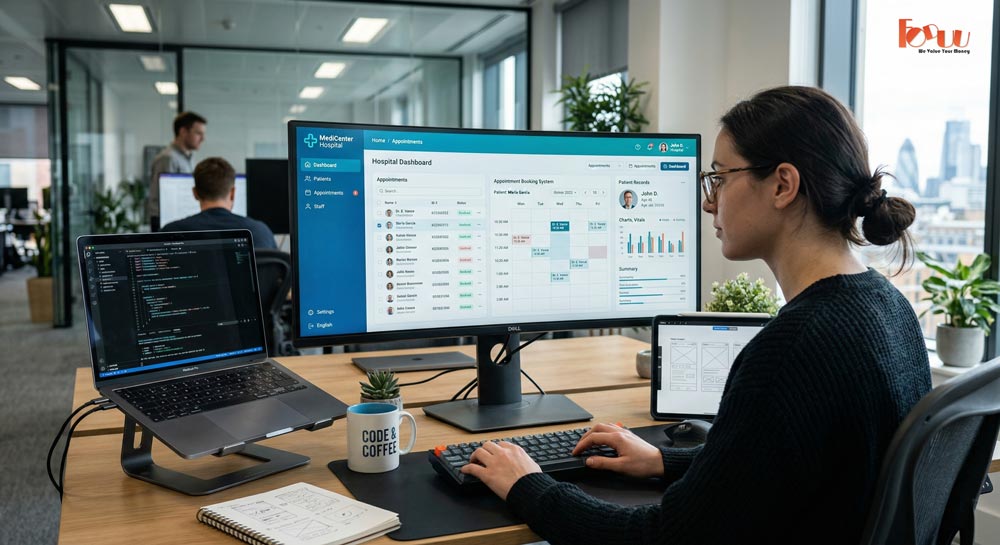

 Today’s patients don’t directly walk into a clinic, they start by searching on Google. Recent data shows that 72% of patients prefer providers with a strong online presence. See the other impressive facts to understand the importance of having a medical website.
57% of patients begin searching before deciding they need care.
77% of patients use Google to research symptoms.
48% of patients look up physician reviews before booking.
37% of patients will not consider a provider with less than 4 stars.
92% trust patient reviews as much as personal recommendations.
61% of searches are location-based (e.g., “dentist near me”).
72% of patients prefer online scheduling options.
36% of patients abandon booking if the website is slow.
42% of new patient opportunities come from local SEO visibility.
28% of patients will choose a competitor if your site looks outdated.
From checking symptoms to booking visits, everything they need begins online. This shift makes your website one of the most important parts of your practice. A strong medical website design keeps things simple, fast, and easy to use.
With the right healthcare web design services offered by a website development company, your website becomes a space, patient’s trust from the very first click. Guide patients to the right information and help them take the next step with a planned medical website development approach. In this post, you will learn everything needed to build a medical website that truly works.
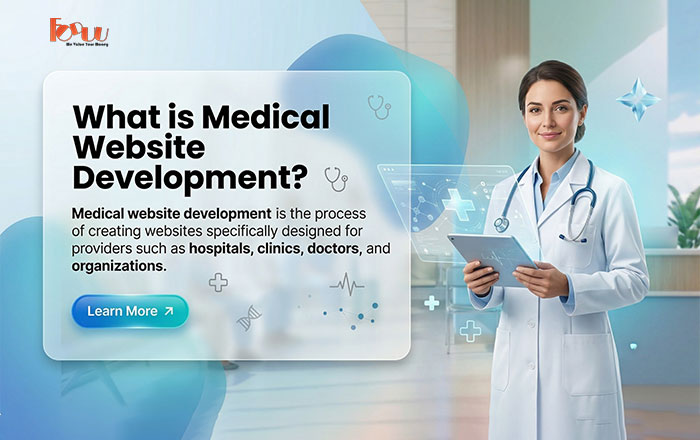
“Medical website development process means to create websites specifically designed for healthcare providers such as hospitals, clinics, doctors, and medical organizations."
The developers focus on building a platform that is visually clean, and easy to use, secure, and reliable for patients. Unlike general Website development, a medical website needs to handle sensitive information, provide accurate details, and guide users without confusion. Every part of the website is built with patient needs in mind, from service pages and doctor profiles to appointment booking and contact forms to HIPAA-compliant data handling to telemedicine.
A strong medical website design also focuses on user experience, clean layouts, easy navigation, and fast loading that works as a central point of communication with patients. In simple terms, medical website development is about building a platform that connects patients and providers.
Without a proper medical website, you’re missing the chance to connect with patients at the right time. Patients today expect quick answers and easy access to healthcare services. A well-planned medical website development approach will help you stay visible, accessible, and ready when patients are searching.
A medical website design reduces patient waiting time, improves communication, and builds trust even before the first visit to your healthcare site. It makes it easy for patients to understand your services, check doctor details, and book appointments. Your website works like a support system for your practice. It handles inquiries, shares important information, and guides users smoothly. So, have a medical website development company work for you and reach out to more patients, serve them better, and grow your practice in a more organized way.
Before diving into development, it’s important to understand why having a website is crucial. Read our detailed guide on why every clinic needs a website to understand its business impact.
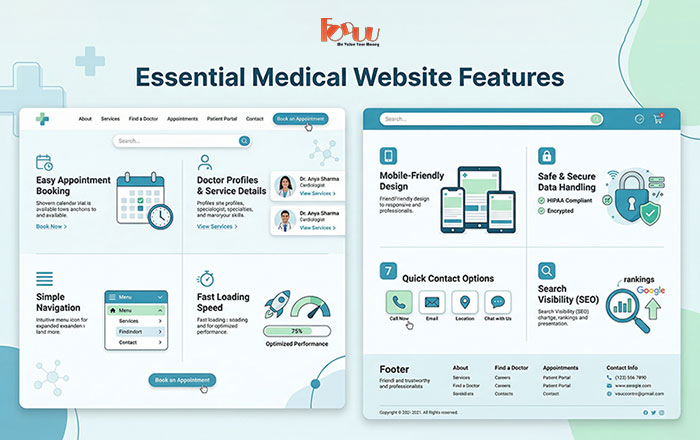
A good medical website is not just about design, it’s about having the right features that make everything easy for patients.
Patients should not struggle to book a visit. In the site, a simple booking button or form will help them choose a time of their liking, just like booking a cab or ordering food online.
People want to know who they are visiting. By seeing details of a doctor, their experience, specialties, and services, patients feel secured before they get to meet them.
Nowadays, most patients use their phones to do everything. With a mobile-first design, you will make it easy for patients who are browsing their site from home or any place else.
As patients will be sharing personal details, so their safety matters. Your site has to be secure and must protect the patient’s information. It must build trust, just like a safe locker protects the important data.
No one likes getting lost on a website. Your website must have clear menus and sections that help patients to quickly find things like services, contact details, or booking options.
A slow website can make users leave, especially when someone needs quick information in emergency. So, keep your website’s page loading speed fast.
There should be call buttons, forms, or chat options in your website that make it easy for patients to connect. For example, a patient can tap once a respective button to call the clinic instead of searching for a number.
Your website must be easily discoverable. When someone searches for a nearby doctor or service, your site should appear on the search engines, so as to help more patients reach you.
Building a medical website doesn’t have to feel complicated. By following the right steps, everything becomes clear and simple.
First, we understand your clinic, services, and what your patients need. This helps us build something that actually fits your practice.
Next, we plan your site's structure like what pages you need, and how everything will be arranged for the patients to easily find things they’re looking for.
Now we design your site's layout. We make sure that the medical website design helps patients to read, explore, and feel comfortable when they use the site.
This is where we build the site by bringing everything together such as add features like booking forms, contact options, and other tools that make your website fully useful.
Before we make your website live, we test everything in it from speed, mobile view, and user experience to make sure nothing feels broken or confusing.
Once everything is ready in your site, the website is launched for the patients to use it.
After we launch your website, we keep on improving it so that it stays fast, secure, and up to date.
Building a medical website becomes easier and more effective when the right technologies are used. These are the tools that help make your website fast, secure, and simple for patients to use.
With Technologies like HTML, CSS, and JavaScript, we help create clean layouts, smooth buttons, and easy navigation in your website so that users can see and explore what is on the screen.
Backend manages data, handles forms, and keeps everything working properly, when the patients want to book appointments or send inquiries. Backend runs the things behind the scenes.
Using CMS like WordPress makes it easy to manage your website content, where you can update pages, add blogs, or make changes without needing any technical effort.
This involves storing important information like patient inquiries, appointments, and website content. Such a management keeps everything organized and easy to access.
Healthcare websites need strong protection, so security tools like SSL, firewalls, and encryption are installed to help keep patient data safe.
With a mobile first design approach, and performance based technology, we ensure that your website loads fast and works smoothly on all devices such as phones, tablets, and desktops.
A good medical website is not just built, but built in the right way. By following these simple best practices, we help your website stay useful, safe, and easy to use by for patients.
Try to avoid too much information on any one of the site's page. By having clear content and simple layout, patients are able to quickly understand your services.
Always think from a patient’s side when building a website. Make sure that it is easy for patients to find doctors, services, and contact details from the site.
Most users visit a website from their phones. So ensure that your website is working smoothly on all devices.
Speed of a website matters to both patients and search engines, as fast loading pages help users to stay longer on it, and improve overall experience.
Protecting patient information with strong security measures is a very important step in building your site's trust and keeping it reliable.
Optimizing the site's content for patient helps them to discover your services online. With proper SEO practices implemented on your site, your website rank will enhance in search results.
Regularly updating your website keeps it fresh and useful. So, add new services, blogs, or updates on the site at regular intervals.
The cost of medical website development can vary depending on what you need in your website. For instance, a simple clinic website will cost you less, while a website having advanced features like booking systems or patient portals will cost more. Also, there are many factors affect the total website development cost, such as design complexity, number of pages, features, and level of customization in it. If a site has few basic few pages and contact forms, then it will be quickly build, while a fully custom platform with integrations will take more time and effort.
Further, if you choose a reliable healthcare website development company or highly experienced teams then they may charge more, but they ensure that your site is made with better quality, security, and long term performance. In simple terms, the cost depends on your goals. The more features and customization you need in your website, the higher will be the investment, better results and patient experience.
A medical website doesn’t always have to be expensive, however with the right approach, you can manage your website development cost without affecting its quality.
Don't add too many features in your site in the beginning. Just focus on the essentials first, as you can always upgrade the site later.
Using platforms like WordPress can reduce your development time and cost, while giving you a flexible. So, choose the right WordPress development services to assist.
You can use pre-built tools or templates to build a site instead of building everything from the scratch, as it will save your time and money.
If you have a set plan to develop your site from the start, then you can avoid mistakes from happening, and also extra the labour on it, which will invite more costs.
Working with a reliable website development company may seem costly, but it saves your precious money in the long run.
A clean and simple design looks better for patients. Having too much fluff in it will add to the development time and cost.
Healthcare websites design trends have changed a lot. In 2026, the focus of a website design has shifted to making websites simpler, faster, and more helpful for patients. Here are some website design that are trending:
Websites are becoming more simple and clutter-free. They have less text n it, more space, and clear sections that help patients to understand things quickly.
With more users using the phones, websites are made for mobile usage, and then they are adjusted to work on the large screens.
Websites are now offering quick booking and automated response systems, which makes the overall user experience smoother for patients.
People are using voice search on the internet. Hence, websites are optimized for patients to find a medical service just by speaking over their device.
Fast websites have become a top priority for patients, who don’t like to wait, especially when their situation is urgent.
Websites have become smarter and helpful to patients as they show relevant information based on a user's needs. This makes the overall experience better.
How long would it take to develop a medical website?
The time for a medical website development depends on your needs. A simple website can take a few weeks, while a more advanced site that has extra features may take longer period of development.
What are the minimum security needs of health websites?
A healthcare website should have basic security like SSL encryption, secure hosting, and protected forms. Having these security needs help keep your patient information safe and build trust.
How expensive is medical website design?
The cost of a medical website design depends on the site's features, design, and complexity. A simple website costs less, while a custom website with advanced features will cost more.
Can I add telemedicine to my site?
Yes, you can add telemedicine features in your site like video consultations and online appointments. This kind of support makes it easier for patients to connect with doctors from anywhere they are located.
How do I get my site HIPAA compliant?
To make your website HIPAA compliant, your site must have a secure hosting, encrypted data, and proper privacy measures. By working with a professional medical website development company, you can ensure that everything is set up correctly in your medical portal.
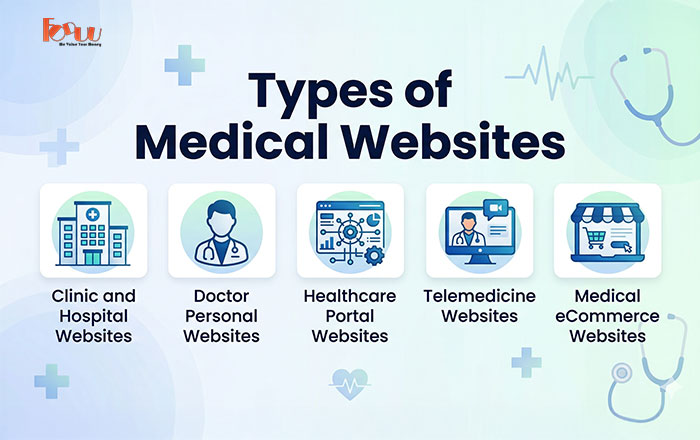
Not all medical websites are the same as Different healthcare providers need different types of websites based on their services and goals.
Clinic and Hospital Websites provide complete information about services, doctors, departments, and facilities. Also, they include appointment booking and contact options for patients.
Doctor Personal Websites allows doctors to showcase their experience, specialties, and services. It helps patients to know more about the doctor before booking a visit.
Healthcare Portal Websites are advanced platforms where patients can log in, check reports, book appointments, and communicate with doctors in one place.
Telemedicine Websites create a path for online consultations using video calls or chat. Here, Patients can connect with doctors without visiting the clinic physically.
Medical eCommerce Websites are used to sell medicines, health products, or medical equipment online.
Creating a healthcare platform comes with its own challenges. One of the biggest concerns in medical website development is keeping the patient data safe while still making the website simple and easy to use. Since healthcare websites handle sensitive information, having a strong security in it is essential.
Also, at the same time, adding too much content or a complex layout in the site can confuse patients instead of helping them.
Another challenge while making a website is to make sure that all features such as booking appointment, patient portals, and contact options should work together.
Also, it is important to maintain a site’s fast loading speed, as sometimes having too many features on it can slow things down. Along with this, you need to ensure that your site is working properly across devices. In this area, a Mobile-First Design approach comes to the aid that makes the site experience smooth on smaller screens.
Small mistakes can affect how patients see and use your website. Here’s a simple way to understand what to avoid and what to do to make a proper website design:
|
Common Mistake |
Right Approach |
|
Showing too much information |
Keep content simple and easy to scan, so patients don’t feel confused using a site |
|
Not designing site for mobile users |
Follow a Mobile-First Design, so your website works smoothly on phones |
|
Slow loading pages |
Optimize site speed, so users browse it quickly |
|
Complicated navigation |
Use clear menus for patients to find things |
|
Weak security setup |
Have strong security measures to protect user data |
A great medical website is carefully crafted for every patient to feel more confident in taking the next step. At FODUU, we focus on turning your ideas into a website that actually works in real life. Our Healthcare Web Design Services are designed to keep things clear, fast, and easy, so your patients don’t have to think twice while using your website.
As a trusted healthcare website design company, we have built several websites that are secure, flexible, and ready to grow with your practice. From the first step to the final launch, we handle every detail with care and clarity. If you want a website that feels simple for patients, but powerful for your business, FODUU will make all the difference.

 1.svg)