Ultimate Website Development Checklist for Businesses
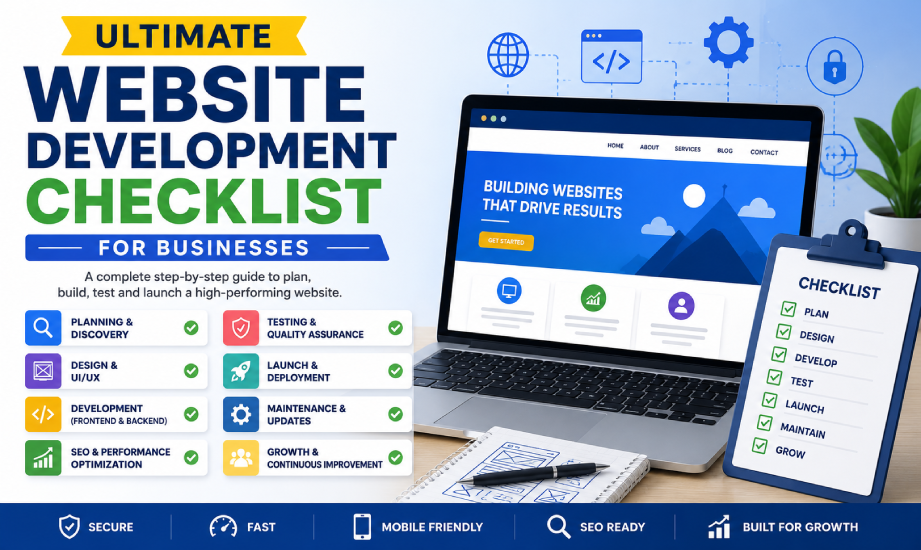

Launching a website without a structured blueprint is a recipe for missed deadlines, bloated budgets, and poor user adoption. In today's hyper-competitive digital ecosystem, your website cannot just be an online brochure, instead it should function as a high-velocity conversion engine that has a highly secure data vault, and a flawless extension of your brand identity.
If you are planning to build an enterprise eCommerce portal, a SaaS landing page, or a corporate hub, this comprehensive blueprint serves as your step-by-step roadmap to help you with your objectives. Partner with an elite website development agency in India and receive absolute world-class engineering talent at highly optimized cost structures.
To successfully navigate an enterprise grade build, you should have a deployment timeline that should be partitioned into six distinct, and non-overlapping operational phases:
|
Phase |
Critical Focus |
Key Deliverable |
Primary Risk if Skipped |
|
1,Planning & Discovery |
Technical Scope & Stack |
Software Requirement Spec (SRS) |
Scope creep & budget overruns |
|
2. Architecture & UI/UX |
User Journeys & Wireframes |
Figma/Adobe XD Prototypes |
High bounce rates & poor UX |
|
3. Frontend & Backend |
Code Quality & System Integrity |
Staging Environment Build |
Broken features & sluggish load times |
|
4. On-Page & Technical SEO |
Crawlability & Core Web Vitals |
Labelled Schema & Optimized Assets |
Zero organic search visibility |
|
5. Quality Assurance |
Cross-Browser & Security Audits |
Penetration Testing Report |
Data breaches & broken layouts |
Before a single line of code is written, you must first have to establish the technical and strategic boundaries of your project. This phase will ensure that you have absolute alignment between your business objectives and your development team's execution framework.
You must select a future-proof technology that is based on your scaling requirements, security guidelines, and long-term business goals:
CMS-Driven Solutions - You can opt for WordPress, Webflow or Shopify for content-heavy or standard eCommerce sites.
Modern JavaScript Frameworks - In this you can choose React, Angular, or Vue.js for high-performance Single Page Applications (SPAs).
Backend Infrastructure - Yu can choose between Node.js, Python (Django), or .NET for secure, enterprise-grade logic.
Database Architectures - You can go for PostgreSQL or MySQL for structured relational data, and MongoDB for flexible NoSQL document storage.
Domain Registration – You must secure your primary .com or country-specific top-level domain (TLD), and ensure that the auto-renewal is enabled to avoid catastrophic downtime.
Premium Hosting Environment - Also, you must establish cloud hosting via AWS, Microsoft Azure, or Google Cloud Platform (GCP). If you have smaller business applications, then select managed platforms like WP Engine or Vercel that offer integrated deployment pipelines.
SSL/TLS Certificates – You must deploy a minimum 256-bit encryption certificate. For enterprise websites handling financial data, then secure an Extended Validation (EV) SSL certificate.
If your platform has an exceptional user interface (UI) combined with an intuitive user experience (UX), then it keeps the visitors engaged and guides them seamlessly down your conversion funnel.
Sitemap & Navigation Hierarchy – You should build a clean, and logical menu structure. There should be no critical informational page in it, as it should ever be deeper than three clicks away from the homepage.
Mobile-First Responsive Wireframes – Have design layouts with a mobile-first philosophy. Over 55% of global web traffic originates from mobile devices, so your site should also render flawlessly on all screens.
Conversion Touchpoints- Have strategically position primary and secondary calls to action (CTAs) in the site. Try to use contrasting colour layouts to guide the user's eye naturally toward form submissions or product checkouts.
Global Design System - You must create an asset library that specifies exact typography scales such as H1, H2, H3 and the Body. Have hex colour codes, button configurations, and icon spacing rules.
Asset Optimization - You must prepare all brand imagery in modern, lightweight formats. Use webp or avif for photographs and svg for logos and icons to maximize screen resolution without sacrificing loading speeds.
This is the engineering phase where your visual designs are translated into functional, clean, and highly secure web components.
Semantic HTML5 & Modern CSS - You must ensure that your engineering team uses semantic HTML tags to build proper data structures for search engine crawlers. This is the kind of modern layouts that are used with CSS Grid and Flexbox.
Component Modularity - You should build your frontend using isolated, and reusable components. This helps in keeping your codebase organized, dramatically reducing duplication, and accelerating future maintenance loops.
Robust Custom API Development – You should build secure RESTful or GraphQL APIs to cleanly connect your frontend user experience with backend servers and databases.
Third-Party Integrations - It is necessary to connect your critical business systems, including Customer Relationship Management (CRM) tools like Salesforce or HubSpot, automated marketing software, and enterprise payment systems (Stripe, PayPal).
Custom CMS Hardening - If you are using an open-source content management system, then customize the administrative backend to prevent non-technical staff from accidentally altering underlying system files.
A beautifully built website is useless if your target audience cannot find it on search engines. So, you must embed SEO in it deep within your deployment phase to ensure rapid indexing and solid initial rankings.
Core Web Vitals Compliance - You should optimize your code to hit Google's strict performance baselines. For instance, your Largest Contentful Paint (LCP) must occur within 2.5 seconds, and First Input Delay (FID) must clock under 100 milliseconds.
Dynamic Meta Tag Deployment - You must programmatically generate unique meta titles that must be under 60 characters and have descriptive meta tags that must be under 160 characters for every page on your index.
Schema.org Structured Data - You must inject JSON-LD structured data into your codebase. This will help search crawlers accurately understand your corporate address, physical locations, products, and reviews. This qualifies your site for lucrative visual rich snippets.
Automated XML Sitemap & Robots.txt - You must set up an auto-updating XML sitemap and upload it directly to Google Search Console. You should configure your robot’s txt file properly to shield private administrative pathways from being indexed.
Before pushing your site live to the public, you must undergo strict quality assurance testing to verify cross device compatibility, ironclad security, and bug free performance.
Cross-Browser Testing - You must validate that your website renders and runs identically across Google Chrome, Apple Safari, Mozilla Firefox, and Microsoft Edge.
Device Responsiveness Validation - You must test UI behaviours across an array of real iOS and Android smartphones, tablets, laptops, and ultra-wide desktop screens.
Broken Link Remediation - You must run automated link-checking software to completely eliminate 404 redirection errors, broken asset paths, and misconfigured external links.
Security Vulnerability Audits- You must change all default administrative pathways, implement brute-force login protection limits, and test inputs for SQL injection vulnerabilities.
Code Compression & Caching - Also, you should minify all production Javascript and CSS files. You must set up advanced server-side caching rules and deploy a Content Delivery Network (CDN) like Cloudflare to serve cached assets from servers closest to your global visitors.
Managing this exhaustive web development checklist requires a multi-disciplinary team of system architects, UI designers, backend engineers, and QA technicians. If you are trying to hire and assemble this entire team in-house, you can instantly exhaust an enterprise's operational budget. What you must do is to outsource your build to a premier website development company in India, as your business unlocks immense advantages:
Exceptional Cost-to-Value Optimization - By accessing elite, senior software engineers and accredited website developers you can lower operational overhead compared to domestic Western agencies.
Round-the-Clock Development Loops - You must utilize the natural time-zone difference to set up continuous deployment cycles, as it will significantly cut down your total time-to-market.
Massive Technical Capabilities - website development companies in India maintain dense, agile engineering teams that are highly proficient in complex modern software solutions from enterprise-grade headless eCommerce setups to custom AI integrations.
A successful website launch is not a static destination, but an ongoing operation. Once your website goes live, then you must secure its long-term health by executing this automated structural maintenance schedule:
Automated Off-Site Backups - Properly schedule the full database and file system backups every 24 hours, and safely store them across isolated cloud servers.
Weekly Patch Management - Remember to update all core CMS codebases, system framework plugins, and technical scripts to patch emerging web security risks.
Continuous Analytics Tracking - Finally, monitor live behavioural data using Google Analytics 4 (GA4), and track the server performance anomalies through automated server health dashboards.
An enterprise-grade website is the ultimate digital asset for your business. By following this website development checklist, businesses can create websites that are user-friendly, secure, SEO-ready, and built for growth. If you're looking for professional website development services, FODUU can help you turn your vision into a high-performing website that delivers measurable results.