The Complete Website Development Process - A Step by Step Guide for 2026
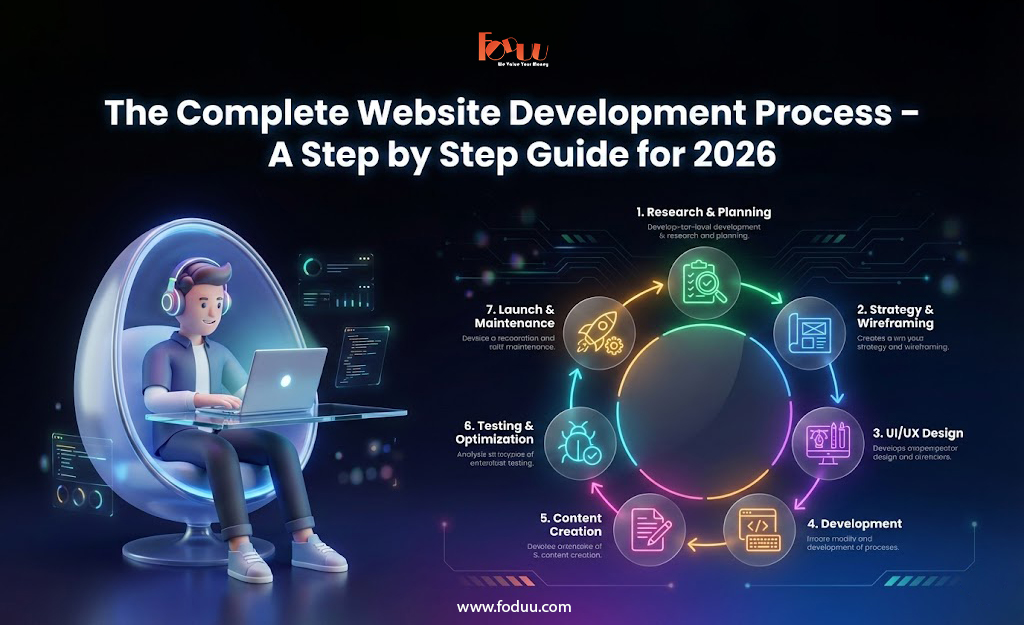

If a website is not providing positive results, then it is not just failing, but failing expensively. Most underperforming websites are not the result of poor design or weak development skills, but of a broken website development process that was never aligned with business goals in the first place.
For example, websites built without a clear performance strategy often suffer from slow user interactions and delayed page responses. Another common issue is poor architectural planning, where scalability and integrations are ignored early on, and making even simple updates costly later. In both cases, the problem is not design or development skill, but the process followed. Over time, every slow interaction, architectural shortcut, and rushed decision quietly adds to long term technical debt.
The modern digital environment has changed how websites are evaluated and rewarded. With AI powered search experiences, mobile first indexing, and edge based delivery, user expectations have increased significantly. When a website feels slow or unresponsive, users leave almost immediately. According to Google Search Central, Interaction to Next Paint (INP) is now a Core Web Vital metric that directly links real user responsiveness to search visibility.
Each phase of the website development lifecycle from discovery and planning to development, testing, deployment, and continuous optimization plays a direct role in speed, security, conversions, and long term ROI. This is why the website development process itself has become a competitive advantage.
This guide breaks down those web development steps to help you build a website that is not just launched, but engineered to grow. Each stage of the process plays a role in how a website performs, scales, and delivers long term value.
However, before we dive into the phases, we must refresh our understanding of website development.
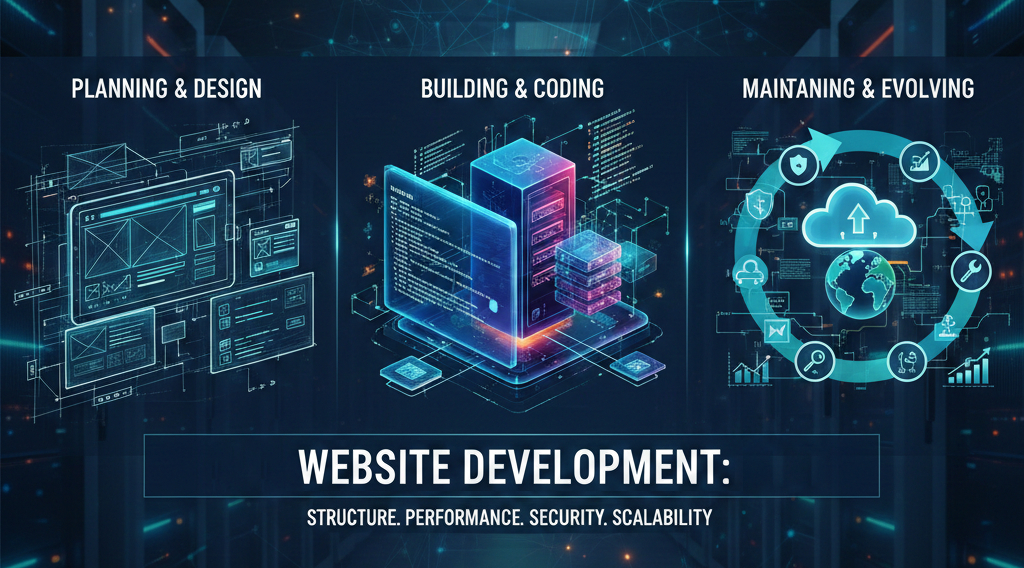
Website development is the process of planning, building, and maintaining a website, so that it can function correctly and deliver real business value. The process goes beyond a site’s design and code. It is about combining structure, performance, security, and scalability into a single system. While design focuses on appearance and user experience, development ensures that a website loads fast, works across devices, and supports future growth.
A website is made up of both what users see and how the site works behind the scenes. The process does not end at the launch phase. It is an ongoing service that is essential to keep a website reliable and effective.
Explore Our in-depth Web Design Insights:
Related Post: [What is Web Design: A Complete Guide]
Related Post: [A Guide to Website Redesign in 2026]
The most critical phase of the website development process begins long before a single line of code is written. Discovery and strategy define what the website needs to achieve, who it is being built for, and how it should grow over time. When this phase is rushed or skipped, even well-built websites struggle to deliver meaningful business results.
The first step in this phase is defining clear business goals.
A website built for lead generation requires a very different structure than an ecommerce platform or a brand authority site. Without this clarity, design decisions become subjective and development efforts lose direction. Discovery ensures that every feature and page supports a measurable outcome.
Also, equally important part of this process is understanding the audience.
Now, effective websites are built around the intent or behaviour of a user. This means identifying why users are visiting a site, what problems they are trying to solve, and what actions they will most likely to take. Such kind of insights influence the development a site’s content structure, navigation flow, and conversion paths.
Further, technical planning plays a major role in the discovery phase.
Here, you must choose the right technology stack such Next js and SvelteKit according to their scalability, performance, and maintenance. Such decisions made at this point allows the easy the site to easily integrate third party tools, future features, and the growth of traffic.
If you see the discovery phase from a strategic perspective, then it is not just a discussion, but a risk control measure taken to prevent issues that can develop later on in a site. For instance, web development projects that skip proper discovery are far more likely to experience 40% higher chance of scope creep, budget overruns and costly rework later.
Once the strategy is defined in phase 1, the next phase of the website development process focuses on planning the structure of a website. This is where ideas are organized into a clear framework that guides both a site's design and development. Here, proper planning helps avoid confusion, rework, and misalignment that can appear later in the project. The process begins with the creation of a sitemap.
What is a sitemap?
A sitemap outlines the hierarchy of a website and shows how pages are connected to each other. It helps teams understand the scope of the site, prioritize key pages, and ensure that important content is easy to access for both the users and search engines.
What is Wireframing?
Wireframing follows a sitemap's planning and focuses on building the basic layout of each page. These are low detail visual guides that define a site's content placement, navigation elements, and user flow. In 2026, wireframes are created with a mobile first mindset, so that smooth navigation and usability can appear on smaller screens before they can scale up to larger devices. Another critical part of this phase is user journey mapping.
User Journey Mapping
A user journey ensures that visitors can move through a website logically and complete actions without causing unnecessary friction. Such paths are developed to improve user engagement and support higher conversion rates.
SEO Planning & URL Structure
Lastly in this phase, SEO is also considered to improve crawlability and long-term search performance. The defining aspect of this stage is a site's URL structure, internal linking silos, and content grouping. These elements directly support crawlability, ensuring that search engines can discover, index, and understand website content without technical barriers. In the end, a website has a clear blueprint that sets the stage for design execution.
Related Post: Website Wireframing: A Step by Step Guide
With a clear structure set in the previous phase, the next part of a website development process moves into UI & UX design and prototyping. The focus here is on shaping a site in that manner, so that users can have a smooth experience and interaction with it. A good design is not about decoration, but about clarity, usability and engagement.
This process begins with a mock-up of a detailed design, which visually represents each page of a website. Such designs define layout, spacing, typography, and visual hierarchy. There are tools such as Figma that are used to create accurate representations a website.
Once the design creation is done, then prototyping follows that plays a critical role in validating ideas. The use of interactive prototype allows teams to test user flows, navigation paths, and key actions before a site development begins. This helps in identifying friction points, which can reduce costly changes during the build phase.
Also, at this point of a site development, is considered accessibility. A website must be easy for all users, even those with visual or movement difficulties. Things like text size, contrast, spacing, and navigation are made simple, so everyone can use the site comfortably.
A website design is not only visually defined, but functionally validated by the end of this phase. This ensures that development must begin with a clear direction, which reduces risk and improves overall efficiency as the project moves into the core build phase.
The development phase is the stage where a website finally starts taking shape. This is the core part of the website development process, where the structure, visuals, and logic of the site are built together. At this point, the work usually begins with frontend development. This is the part of a website where users see and interact with it directly. It includes things like page layouts, navigation menus, forms, and other interactive elements.
Frontend Development (Client-Side Development)
When a frontend is built properly, then a website is fast, easy to use and remains consistent across different devices. Modern frontend development often uses frameworks such as React 19, Vue 3, or Astro, depending on the project type and content requirements. They use clean UI principles and minimal JavaScript usage to reduce complexity.
Performance of a website is a key priority in this segment of development because a site’s slow interface can lead to poor user experience and less engagement. To reduce latency here, Server Side Rendering (SSR) and Edge Rendering are applied.
Backend Development (Server-Side Development)
The next part of the website development process is the Backend. In the backend, the things to take care are data, user requests, and integrations with external systems. A well-structured backend follows an API first architecture, and allows a website to handle higher traffic easily, also you can add new features in it without rebuilding the whole site.
Such an approach often includes the use of a headless CMS, where content management is separated from presentation. Some commonly used Backend optimization methods involve working with Redis for caching and databases such as PostgreSQL or MongoDB to support scalable and reliable data management.
Both the frontend and backend are built as separate systems in the modern web development process. Such kind of difference improves a site’s flexibility, and makes it easier to update or expand the website whenever the demands change.
Another critical area of the development phase is a website's security. A user information and the business assets have to be protected at all costs. So, it is necessary to have a site's data handling, access control, and secure system architecture to be correctly completed. Security implementation follows principles such as Zero Trust architecture and end to end encryption to safeguard user data and business systems.
It is only after the above steps are fully implemented, a website will become stable, scalable, and is ready for testing. If the issues are identified at the right time before a site’s launch, then a website will meet performance standards and be able to deliver a reliable user experience.
A website is thoroughly examined at the testing phase before it goes live on the internet. To ensure that everything functions as it should, a website has to be evaluated, so that there is a low possibility that a site will face less issues on its debut.
In this process, the first step is of the Functional testing. Here, every page, button, form, link, and interactive element is evaluated to ensure the site’s functionality. The functional testing ensures that there are no small problems on the site as even as mere issue can have a major impact for a user to see the platform as trustworthy.
The next step in this process is cross browser and device testing of a website on different browsers, screen sizes, and devices. This ensures that users will get a same user experience no matter where they are accessing a site from like a desktop, tablet, or mobile phone.
Also, involved during this phase is performance testing of a website. The performance elements reviewed in this process are page loading speed and responsiveness. Tools such as Google Lighthouse are commonly used to benchmark performance and identify optimization opportunities. The Performance benchmarks are validated using Core Web Vitals, including Largest Contentful Paint (LCP), which is under 2.5 seconds and Interaction to Next Paint (INP) is under 200 milliseconds.
If a site has slow pages, then it can lead to higher bounce rates and lower engagement. So, it is necessary to fix performance issues beforehand a site is made live.
Another important part of Phase 5 are the security checks. These checks specifically test for vulnerabilities such as SQL injection, cross site scripting (XSS), and improper input validation. Such an inspection helps protect the business and its users from avoidable risks. The aspects to be reviewed here include user data and system access points that ensures the basic security measures are in place. Also, you need verify before launching a website is the SSL certificate validity and secure HTTPS enforcement.
Further, you can work with Burp Suite and Snyk that are commonly used to identify application and dependency level risks.
After testing is completed, a website moves into the deployment and launch phase. This is the stage where the site is prepared for real users and made live on the internet. Even though the website may look finished at this point, this phase is not just about pushing a site live. It is about ensuring a smooth transition from development to production.
Deployment Planning
Here, deployment planning is the first step in this phase, which includes setting up the hosting environment, configuring servers, connecting domains, and ensuring that databases and integrations work correctly in the live environment. This includes configuring production infrastructure on platforms such as AWS, Google Cloud, or Vercel depending on scalability and performance requirements. Such measures help a site to not have any downtime or unexpected errors.
Once a website is made live on the internet, then some final checks are carried out such as verifying page loading, forms, tracking tools, and basic security settings. Also, a final SEO validation is performed, including submitting the XML sitemap to Google Search Console to ensure proper indexing.
This confirms that everything is functioning in a website. A careful monitoring is performed on a site to find out any issue as even a small error at this stage can affect a user's trust. By integrating analytics tools such as Google Analytics 4 and behaviour tracking heatmaps like Hotjar, you can track real user activity.
After a site is launched, the website then enters continuous optimization to monitor real user behaviour. To understand performance, engagement, and conversion patterns, a site undergoes updates, fixes, and improvements. Also, such measures keep a site fast, secure, and aligned with business goals.
A successful website experiences ongoing optimization to ensure that it has long term performance, scalability, and sustained ROI.
The work on a website does not stop once it is launched. Post launch is now the Growth Phase, where continuous improvements are made to make a real difference in a site’s performance, security, and overall user satisfaction. A website that is actively maintained will keep delivering results and continues to grow with your business.
By using AI, your website can adapt and change content dynamically based on how users behave. This means every visitor can see a more relevant experience, which improves engagement, and keeps them interested, and encourages them to take action.
Also, keeping everything on a site up to date is essential. You need to update the site’s libraries, plugins, and dependencies on a regular basis to prevent security. Without a site’s regular patching, even a strong website can slowly become exposed to threats or technical issues.
Conversion Rate Optimization (CRO)
CRO is about testing what works and what doesn’t on a site. By performing continuous A/B testing of landing pages, forms, and calls to action, you can see which things are performing better.
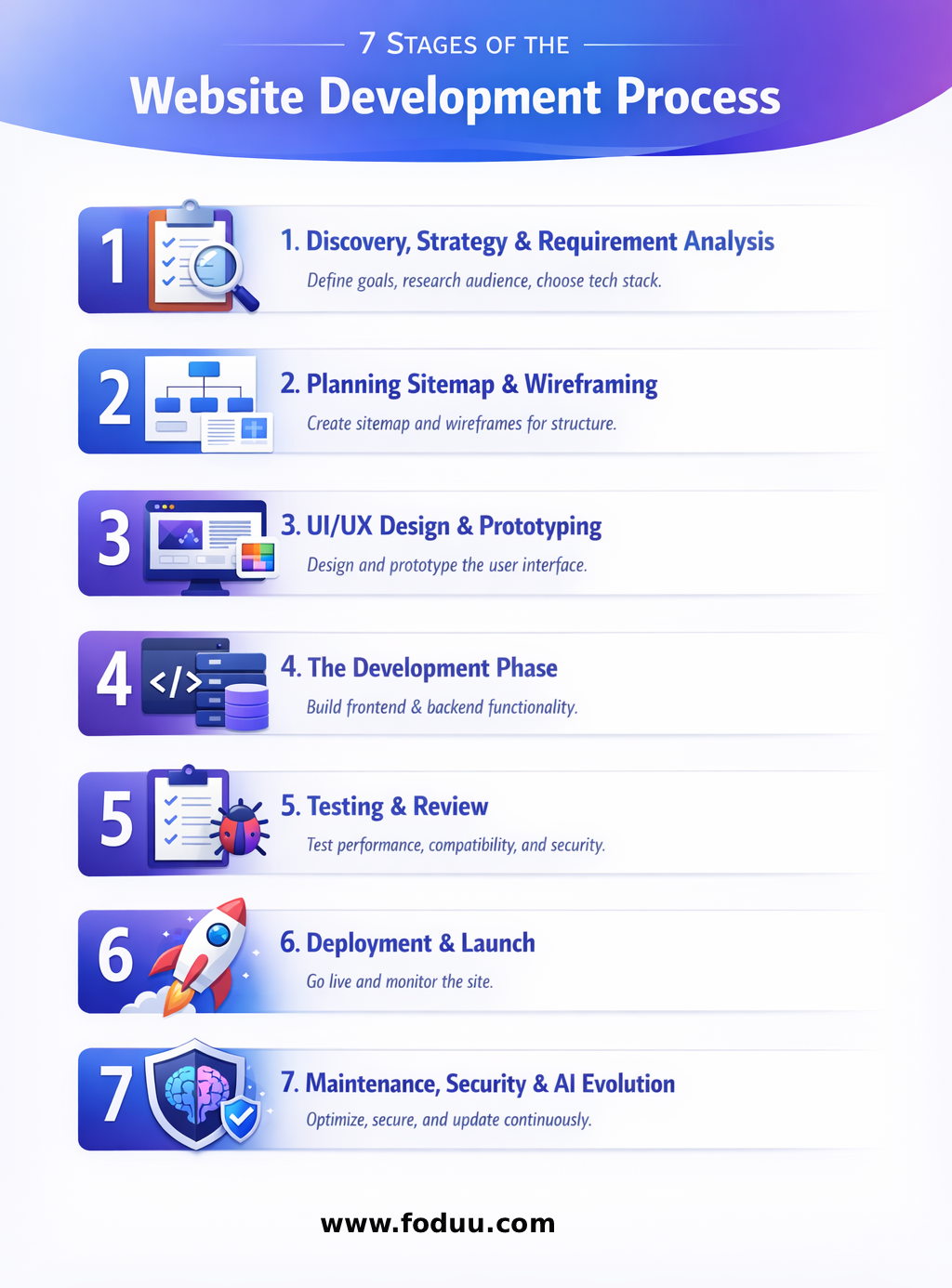
A well-structured website development process ensures clarity, efficiency, and measurable results. The flowchart below visually represents how a professional website moves from initial concept to successful launch and continuous optimization.
A website is built by designers, developers, testers and project managers.
Website Designers make a site look nice.
Website Developers who build a site and make it work.
Testers check everything is correctly functioning in the site.
Project managers make sure that everyone stays on track.
You want a website development company that understands what your business wants, has the right skills, and can build a website that works well on all devices, loads quickly, stays secure, and can grow as your business grows. So, you need to pick the right company.
A professional web development company in India guides you through planning, design, development, and ongoing support, so you can understand the requirements and give your website true value over time.
Mastering the website development process turns your site from just a page on the internet into a real business asset. If you follow these steps in your life, then your website will become fast, safe, and ready for the AI-powered world.
If you are planning to build a future-proof website, then schedule a consultation with our team and let’s make your vision a high-performance reality.