What is Web Design: A Complete Guide

In a world where digital is prioritized, your website is the one that introduces you. A small local shop, a massive company, or a personal brand, the very first way through which most people will know you is the internet. And web design is the factor that determines that interaction.
Some business owners usually think that web design only involves the appearance of a website. In fact, it merges four different fields - creativity, psychology, technology, and strategy. The good visual design of a site extends beyond the mere looks but also affects the user experience, impresses, and changes the visitor's attitude towards the brand, and, thus, ultimately decides whether the visitor will stay, explore, or leave.
This blog explains the real meaning of web design, the actual work of web designers the importance of web design for businesses, and the right ways of approaching it through the help of an appropriate website development company.
Web design is the creation of a plan, ideas, and the arrangement of the content that is published on the internet. It is not simply a matter of choosing the colours and putting the pictures in the right place. The main purpose of an excellent responsive web design is to make the website
functional
user-friendly
fast
visually in line with the brand
Contemporary web design is composed of the following parts:
UI (User Interface) design: The visual presentation of a website.
UX (User Experience) design: How users come to terms with your site and how accomplishing their objectives becomes easy for them.
Visual design: The colour, typography, layout, photo, and branding elements.
Responsive design: That the website runs flawlessly on mobile phones, tablets, and desktops.
Interaction design: Some examples of the very small interactions that can be included in the site are animation, button effect, scroll behavior, etc.
Ultimately, web development is a compromise between the aesthetically pleasing and the practical aspects of a site. A site developer with amazing visual skills but poor user-friendliness will cause people's frustration; on the other hand, a very well-functioning but unattractive site will leave a bad impression of your brand.
Explore Our in-depth Web Design Insights:
Related Post: [A Complete Guide to Responsive Web Design]
Related Post: [7 Reasons Why Visitors Leave Your Website in 5 Seconds ]
Related Post: [Best Tools for Professional Website Designers ]
Related Post: [A Guide to Website Redesign in 2026]
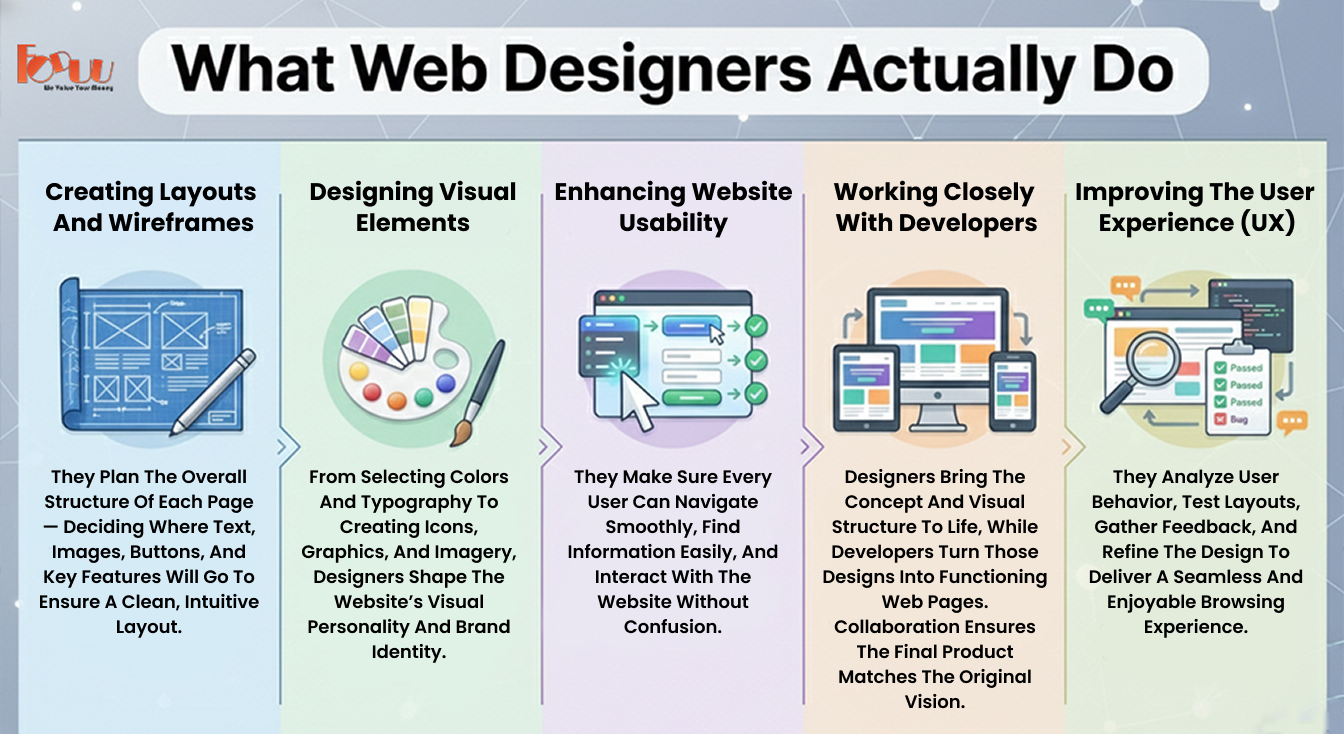
Web designers in india are the ones who make your brand's message, tone, audience's preferences, and business goals mesh together and then they convert them into a digital experience. Their work usually involves:
1. Creating Layouts and Wireframes
They come up with the web design plan, visualizing which parts of the page will contain text, pictures, buttons, and features.
2. Designing Visual Elements
Designers do everything from choosing the font and colour to creating the icon and imagery. Through these, the designers present the brand’s personality in the digital world.
3. Ensuring Website Usability
They ensure that users have smooth navigation, easily fulfilling their needs and grasping how the site works.
4. Collaborating With Developers
Web designs and developments are two-stage processes that need to be completed hand-in-hand, working closely. Designers come up with the idea and prepare the design; developers turn that idea and design into reality by writing the code.
5. Improving User Experience
Designers also take part in the testing of the layout, changing it according to the feedback, and ensuring that the journey of the user is easy and enjoyable.
To sum up, a web designer carries the personality of an artist, the mentality of a problem-solver, and the mindset of a strategist.
Related Post: [Website Development Process - A Step by Step Guide for 2026]
The salary of a web designer changes with their experience, place of living, and area of expertise. As a rule, their wages can be limited to the minimum for a beginner and can later double as high as a top-tier professional income.
An inexperienced designer may be granted a somewhat low salary while getting to know the necessary instruments and creating a portfolio. After gaining some practice, perfecting their skills, and choosing a suitable field, like user experience, user interface, or product design, income may reach an astonishing level. Also, a freelancer can get a higher salary if there is a great demand for his services and a long-term project.
To put it briefly, a web designer is one of the professions where the enhancement of one's skills leads to the increase of one's income.
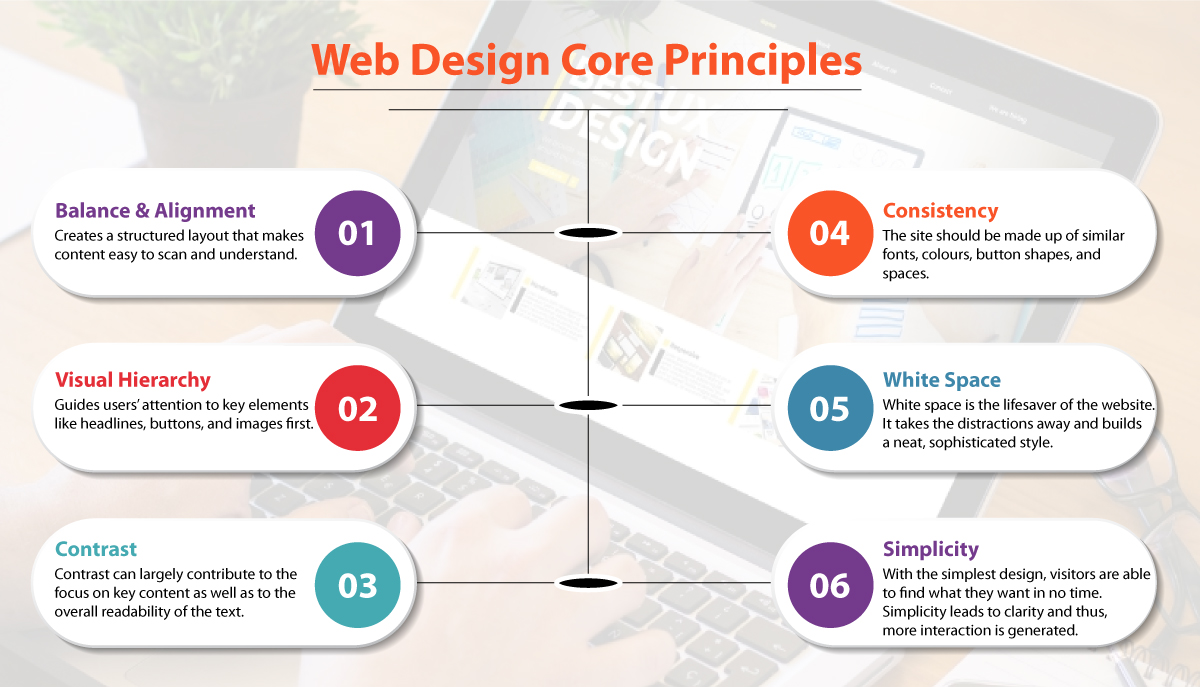
Great websites are the result of following timeless design principles that make them intuitive and visually pleasing. Some of the most important principles include:
1. Balance and Alignment
Balance and alignment in the layout are what make a website look well-organized. This enables users to understand the information in a quick and comfortable manner.
2. Visual Hierarchy
The eye of the viewer should be attracted to some elements more than the others - such as headlines, buttons, and images. The designers bring this effect using size, colour, spacing, and the position of the elements.
3. Contrast
Contrast can largely contribute to the focus on key content as well as to the overall readability of the text. It makes sure that the writing is easy to see and that visitors can tell the different parts of the website.
4. Consistency
The site should be made up of similar fonts, colours, button shapes, and spaces. This not only deepens branding but also makes the site easier to use.
5. White Space
White space or negative space is the lifesaver of the website. It takes the distractions away and builds a neat, sophisticated style.
6. Simplicity
With the simplest design, visitors are able to find what they want in no time. Simplicity leads to clarity and thus, more interaction is generated.
These principles render a website not only attractive but also functional, something every business requires.
A website is the digital face of a brand. It can either make people trust you or just drive them away. Here is the list of reasons why good web design is vital:
1. First Impressions Are Everything
Within a few seconds visitors decide if they want to stay on your site or not. If the site looks attractive and is easy to navigate, this will lead to instant trust.
2. Your Competitors Are Investing in It
Almost in every industry, the coming trend is businesses modernizing and upgrading their websites. Old-fashioned and awkward webpages make you look unprofessional.
3. Good Design Boosts Conversion Rates
By implementing a user-friendly interface, fast loading time, and a visually pleasing layout, the intention of the visitors will most probably be to convert (purchase, register, contact, etc.).
4. Web Design Impacts SEO
Search Engines like Google.com love websites that deliver excellent user experience. Hence, good-quality design equals higher rankings.
5. It Strengthens Branding
Features like colour, imagery, and typeface help the brand to create an emotional bond with customers. An expertly crafted site will make your company stand out.
6. Mobile Responsiveness Is Now Mandatory
Since most users are surfing on mobile, a website must be perfectly functional across various screen sizes to be user-friendly.
In the end, a successfully designed site is more than an online presence; it’s a business asset that directly contributes to growth.
Website creation is a multi-step process, with each stage being important to the final result. Typically, this is the smooth workflow that is involved:
1. Understanding the Brand and Goals
Learning the brand identity, target customers, and business objectives must be done before starting any design work.
2. Creating Structure Through Wireframing
Wireframes serve as the building plan which helps organize the content, layout, and navigation in a logical way.
3. Designing Visual Elements
Designers focus on colours, typography, and images as well as interactive elements once the framework is given the green light.
4. Development and Implementation
With coding languages and platforms, developers bring the design to life as a working website.
5. Testing and Optimization
The website goes through testing for bugs, compatibility with devices, loading speed, and general user-friendliness.
6. Continuous Improvement and Launch
Websites, even after their launch, require updates, content refreshes, and optimization to be able to keep their place in the market.
Related Post: Website Wireframing: A Step by Step Guide
Building or updating a website and making the final product effective, attractive, and user-friendly mainly depend on a number of fundamental considerations. These aspects are not only to make your site look good but also to ensure its smooth performance and support your business goals. This is what really counts:
1. Put User Experience First
The target users must not experience any confusion, frustration, or disorientation. The pages, buttons, and interactions should instinctively lead users to what they want.
2. Keep Navigation Clear and Straightforward
The descriptions of menus, categories, and links should be simple enough that even a child can understand them. Simple navigation methods allow the users to explore your site effortlessly, whereby efficient engagement and lower bounce rates take place.
3. Use Visuals That Represent Your Brand
Design features such as colours, typography, images, and icons need to be in harmony with the character of the brand. By using the same visuals, your website becomes a strong brand and is perceived as reliable.
4. Prioritize Fast Loading Speeds
Slow websites can make their users angry; thus, users will just simply leave such websites. Therefore, website owners must be sure of optimized images, codes, and hosting so that the website users do not have to wait long hours to access their desired information.
5. Make Your Website Fully Responsive
The website must be visually attractive and fully functional on mobile devices, tablets, laptops, or desktops. A responsive design guarantees a good user experience across different screen sizes.
6. Avoid Unnecessary Clutter
Overloading with items can make users mentally exhausted. A cleanly designed site with well-spaced areas makes your important information stand out and allows for easy navigation.
7. Maintain Branding Consistency Across Pages
Every page should be perceived as the continuance of the brand story. Brand recognition and professionalism are deepened by the uniform use of fonts, colours, and design elements.
8. Update and Improve Regularly
Modern technologies have created a concept of websites that are perpetual works in progress. Web trends, content, and user expectations are never constant. The continuous changes keep your site up-to-date, safe, and effective.
These givens, as the basis of your design work, will ultimately bring you a website that looks considerate, modern, and in line with your business identity, something that every visitor will be left with a positive and lasting impression of.
Besides being a creative skill, web design is a strategic business tool. Your website's quality is a major factor that determines your success in the digital world, as it leads to trust, credibility, conversions, and growth.
An attractive and well-organized website is not only a way to get people to visit the site but also a means of keeping them loyal and motivated to do what you want (e.g., buying something, signing up, downloading, etc.)
There is no doubt that spending a reasonable amount of time and money for building a high-quality website is, in fact, a wise decision for your business. This is true whether you are creating a new site or redesigning an old one. It plays a major role in:
how people perceive you,
how they interact with you, and
most importantly, if they decide to get connected to your brand or not.