The Complete Guide to Website Development for Businesses


In modern times, every business needs a strong online presence to help them stay competitive. Whether it is a small local store or a global company, a website helps businesses have a digital storefront, where online customers can learn about their products, services, and brand values. A website should be developed with all the critical facts included, such as its right building, structuring, so that they can function smoothly on all different devices and browsers. Studies show that there are over 1 billion websites on the internet, which highlights how important it is for businesses to establish their presence online.
A website does more than just displaying some information. It helps businesses to improve user experience, reach a wider audience, and support marketing efforts such as Search Engine Optimization (SEO). By designing a website’s responsive layout to building complex web applications, it is ensured that a site will perform efficiently and delivers value to its users.
In this post, you will learn what is website development, why it is important, how it differs from web designing, the tools, languages, and the trends shaping it?
In many cases, websites today are not just simple online pages anymore. They are slowly becoming AI-first digital platforms that help businesses grow, attract customers, and provide useful information to users. Because of this change, search engines are also evolving. New approaches like Generative Engine Optimization (GEO) and Answer Engine Optimization (AEO) are becoming important for modern websites. These strategies help websites appear in AI powered search results and answer engines.
Because of this shift, choosing the right website development company and the correct technology stack has become a very important business decision. A well-developed website not only improves performance and security, but it also helps businesses stay competitive in the fast changing digital world.
Website development can also be explained as the process of building and maintaining websites for the internet or an internal company network (intranet). In many cases, it involves different technical components that work together to make a website function properly. At the same time, website development usually includes three important parts of a technology stack.
The first part is the client side, which is also called the front end. This part controls what users see and interact with in their web browsers.
The second part is the server side, which handles the logic, requests, and processing behind the scenes.
The third part is the database, where important website data such as user information, products, or content is stored and managed.
Further, people confuse a website with a web application, which in fact both are slightly different. A simple website usually provides information such as company details, blogs, or service pages. On the other hand, a web application is more interactive and allows users to perform actions like logging in, sending messages, managing accounts, or making online purchases. Because of this, web applications usually require more complex development and stronger backend systems.
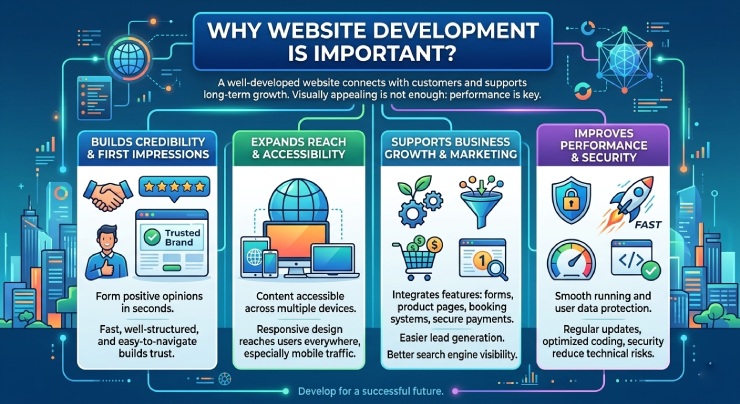
A well-developed website helps companies connect with potential customers, and supports long term growth. Without proper development, even a visually appealing website may struggle, as it will have a slow loading speed, poor functionality, or limited accessibility. Here are some points that demonstrate the importance of website development
Site Builds Credibility and First Impressions - When users visit a website, they often form an opinion about a business within seconds. Seeing that the website is fast, well structured, and easy-to-navigate website, then users form a positive first impression about the brand and builds trust with them.
Expands Reach and Accessibility - A website ensures that people can access your content on multiple devices such as smartphones, tablets, and desktops. Since a large portion of internet traffic now comes from mobile devices, a responsive website allows businesses to reach users wherever they are browsing.
Supports Business Growth and Marketing - Website enables businesses to integrate useful features with them like contact forms, product pages, booking systems, and secure payment options. These tools make it easier for visitors to interact with the business, generate leads, and complete purchases online. Also, a well-structured website helps search engines to understand content, which supports better visibility in search results.
Improves Performance and Security - Strong development practices keeps a website run smooth, and protects user data. Its regular updates, optimized coding, and security measures reduce the risk of technical issues, which builds confidence among visitors using the website.
Many people use the terms web development and web design interchangeably, but in reality, both of them refer to different aspects of building a website. Web design focuses on how a website will look and give feeling, while web development focuses on how the website works and functions. The following comparison shows a clear difference between the two of them:
Aspect |
Web Design |
Web Development |
|
Focus |
Visual appearance and user experience |
Technical structure and functionality |
|
Main Goal |
Make the website attractive and easy to use |
Make the website work smoothly and efficiently |
|
Responsibilities |
Creating layouts, colour schemes, typography, and UI elements |
Writing code, building features, managing databases |
|
Tools Used |
Design tools like FIGMA, Adobe XD, Photoshop |
Programming languages and frameworks |
|
Example Task |
Designing the homepage layout and navigation |
Coding the menu, forms, and interactive features |
|
Role in a Website |
Decides how the website looks |
Ensures the website functions properly |
To create a website, the web designers and web developer’s work together to give a solid outcome.
A web developer is responsible for building and maintaining the technical structure of a website. They turn a website’s design concepts into a fully functional website by writing code, integrating systems, and ensuring everything works smoothly across different devices and browsers. The following points describe their main work:
Converting Design into Functional Pages - Web developers use the layout and design created by web designers and transform it into a working website. They do so by writing code that controls how elements on a site such as buttons, menus, images, and forms behave when users interact with them.
Developing Website Features - Also, developers create interactive features on a site that improves user experience when they interact with contact forms, login systems, search functions, shopping carts, booking systems, and other dynamic tools.
Ensuring Website Performance - Another important responsibility of a developer is to make sure that the website will load and run smoothly. They do so by optimizing code, compressing resources, and implementing best practices.
Maintaining and Updating the Website - After a website is published on the internet, developers still work on it by fixing bugs, updating features, and improving security. They perform regular maintenance on a site to ensure that a website stays functional, secure, and compatible with new technologies.
Web developers are of three types, and so are the specialized roles which are:
Front end developers
Back end developers
Full stack developers
DevOps engineers
Security specialists
Front end developers work on the visual and interactive parts of a website that users see and interact with.
Back end developers handle the server, database and application logic that give power to a website. They work behind the scenes.
Full stack developers work on the entire development process including building the interface to managing server side functionality.
DevOps engineers help developers deploy websites and applications to live servers. They manage hosting environments, monitor system performance, and make sure the website can handle traffic properly. In many cases, DevOps engineers also automate deployment processes so that updates can be released more smoothly.
Security specialists focus on protecting websites from cyber threats, hacking attempts, and data breaches. Because of this, they check website code, security systems, and server configurations to make sure user data and business information stays safe.
The website development process involves the following steps:
The first step is the planning and research phase, where goals and requirements are defined.
The second step is the site’s design and wire framing it, which also outlines the layout and user experience.
Third step is to code and develop a website.
The fourth step is to add content and integrate SEO technicalities.
Fifth step is to test a site, so that to identify issues on it and fix them.
The sixth and seventh step is to publish the website on the web, and maintain it. Also, here updates have to be added on it so that its performance, security, and compatibility stays intact.
Front-end development involves the technologies and programming languages that control how a website appears and behaves in a user’s web browser. In simple terms, it focuses on the parts of a website that visitors can see and interact with directly. The three primary languages used in front end development are Hyper Text Mark-up Language (HTML), Cascading Style Sheets (CSS) and JavaScript.
HTML creates the basic structure of a website. They are used to make headings, paragraphs, images, and links.
CSS creates the visual styling of a website. They work on a site’s colours, fonts, spacing, layouts, and design elements.
JavaScript adds functionality and interactivity to a site’s webpages. They add features like animations, interactive menus, perform dynamic content updates and validate form.
TypeScript - In many modern websites, developers also use TypeScript, which is an improved version of JavaScript. TypeScript helps developers write more structured code and manage large website projects more easily. Also, at the same time, developers use different front end frameworks such as React, Vue js, and Next js. These frameworks help developers create modern, responsive, and interactive websites more efficiently.
Golang - Another backend language that is becoming more popular is Go (Golang). Many developers use Golang for building high performance web applications and cloud based services.
Django, Laravel, and Express - Further, backend frameworks such as Django, Laravel, and Express js are also widely used by developers. These frameworks help developers build secure and scalable websites more efficiently.
Backend development focuses on the server side technologies that power a website. They ensure that everything functions correctly behind the scenes. Back-end handles data processing, application logic, and communication with databases. In the process, several programming languages are commonly used for back end development such as Python, PHP, Java, Ruby, and Node.js.
With these languages, developers create systems that manage user requests, process information, and deliver the correct content to the user’s browser. For example, when someone logs into a website, submits a form, or completes an online purchase, the back end system processes that request securely and retrieves the necessary data from a database.
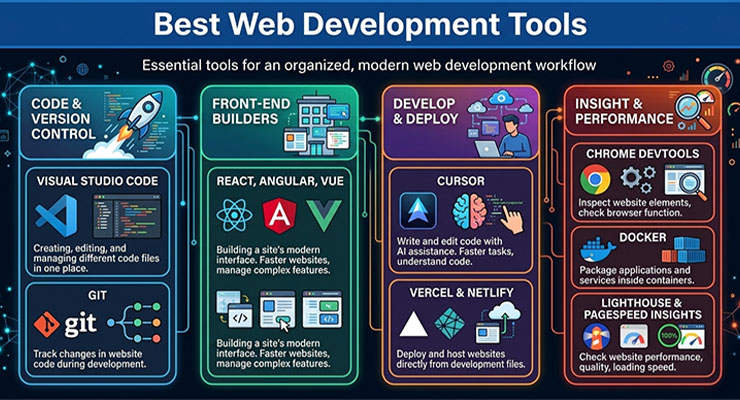
Web developers usually use many different tools to make the development process easier and more organized.
Visual Studio Code tool helps in creating, editing, and managing different code files in one place.
Git tool helps to track changes in the website code during the development process.
Chrome DevTools tool helps to inspect different website elements, and check how the page works inside the browser.
React, Angular and VUE tools help in building a site's modern interface. By using it, one can create faster websites and also manage complex features.
Cursor tool helps developers write and edit code with the help of AI assistance. They help understand code better and also complete coding tasks more quickly.
Vercel platform helps developers deploy and host websites on the internet.
Netlify platform helps in deploying and managing websites directly from the development files.
Docker tool helps developer package applications and website services inside containers.
Lighthouse tool helps developers check website performance and quality.
PageSpeed Insights tool helps analyse website loading speed and performance.
Web development and SEO often work together when a website is being built and improved. For example, when developers create websites with faster loading speed, mobile friendly pages, and a simple website structure, then search engines can crawl and index the pages more easily. At the same time, a site's clean code structure and well-organized content also helps search engines to understand what the website content is about.
Further, developers help in SEO by creating simple URLs, optimizing images, and making sure the website works properly on different devices like phones, tablets, and computers. Because of this, when web development and SEO are planned together, the website will usually perform better and can attract more visitors from search engines. In many cases, search engines also look at something called Core Web Vitals to measure website performance. These include metrics like Largest Contentful Paint (LCP), which checks how fast the main page content loads, and Cumulative Layout Shift (CLS), which measures how stable the page layout is while loading. Because of this, developers try to improve these factors so that the website performs better.
At the same time, developers may also add schema markup to a website. This is a type of structured data that helps search engines understand the website content more clearly. Another important factor is mobile first indexing. In many cases, search engines now evaluate the mobile version of a website first. Because of this, developers make sure that websites work properly and load quickly on smartphones.
Website development continues to grow and change as technology keeps improving and user expectations keep increasing.
In many cases, businesses are now focusing more on modern and advanced website technologies in order to stay competitive. Because of this, several trends are expected to become more common in 2026.
One important trend is the use of AI-powered tools in web development. In many situations, these tools help developers write code faster and complete development tasks more easily. At the same time, progressive web applications (PWAs) are also becoming more popular because they allow websites to work more like mobile apps.
Another growing trend is mobile-first development, because many users now browse the internet mainly through smartphones. Because of this change, developers are focusing more on faster loading speeds, stronger website security, and better overall user experience.
Generative UI technology allows website interfaces to adjust in real time based on how users interact with the site. By using this approach, websites can present content in a more dynamic way and create a smoother user experience.
Headless CMS helps separate website content from the visual design and frontend structure. Because of this separation, developers can manage content more easily and also deliver it across websites, mobile apps, and other digital platforms.
Modular architecture helps developers build websites using smaller, reusable components instead of one large system, and with this approach, developers can update specific sections more easily and also maintain the website in a more efficient way.
Serverless computing allows developers to run backend services without directly managing servers or infrastructure, and by using this technology websites can scale more easily and handle traffic without complex server management.
Edge computing processes website data closer to the user instead of sending every request to a distant server, and because of this websites can load faster and provide a quicker browsing experience for visitors.
AI-driven personalization helps websites understand user behaviour and show content that matches individual interests, and with this technology, businesses can create more relevant experiences and keep visitors engaged for longer periods.
Voice search optimization helps websites support searches that users perform by speaking instead of typing, and as voice assistants become more common, this approach helps websites stay accessible and easier for users to find.
Visual search technology allows users to search using images instead of traditional text queries, and by supporting this feature websites can improve product discovery and provide a more interactive way to explore content.
Website development cost vary depending on several factors such as the overall complexity of the website, the number of pages, and the type of features involved in building a website. The cost of a website is usually less when simple templates are used. On the other hand, websites that include custom designs, advanced features, and deeper SEO integration require more development work, then their price is high.
Many businesses think of website development as an expense. However, in reality, a web development process is a long-term digital investment because it attracts visitors, generates leads, and supports business growth. Such kind of work provides value over time which can be much greater than the initial development cost.
Also Read: How Much Does Website Development Cost In India?
It usually takes a few weeks to build a simple website with basic pages and information. However, if the website is of large size and includes features like login systems, payment options, custom tools, then the development process can take a few months. So, mostly the exact time depends on the size of the website and the level of functionality required.
It is possible to build a website using simple website builders and ready-made templates. However, if someone wants to create a more flexible and fully functional website, then it can be very helpful to hire a website development company instead of using a DIY builder as they can customize websites, add useful features, and make sure the website works properly.
A web designer is the person who plans how the website will look and feel for the users. A web developer is the person who builds the website and makes all the buttons, pages, and features work properly.
In many cases, modern websites are designed to work properly on mobile phones and tablets. At the same time developers also follow basic SEO practices so that the website can be found more easily by search engines.
A website is not just a set of pages on the internet, but in many ways it works like a living digital space that needs regular care and improvement over time. Therefore, a website should be built on a strong foundation of modern code, good design, and proper structure so that it can perform well and support future technology changes. The digital world is now moving toward AI-driven experiences, faster platforms, and smarter user interactions.
If you already have a website, it is a good idea to review it and check if it is still meeting modern development and performance standards. In many situations, working with a professional website development company in India can help improve your website and prepare it for the next stage of digital growth in the coming years.