How Much Does Website Development Cost In India?
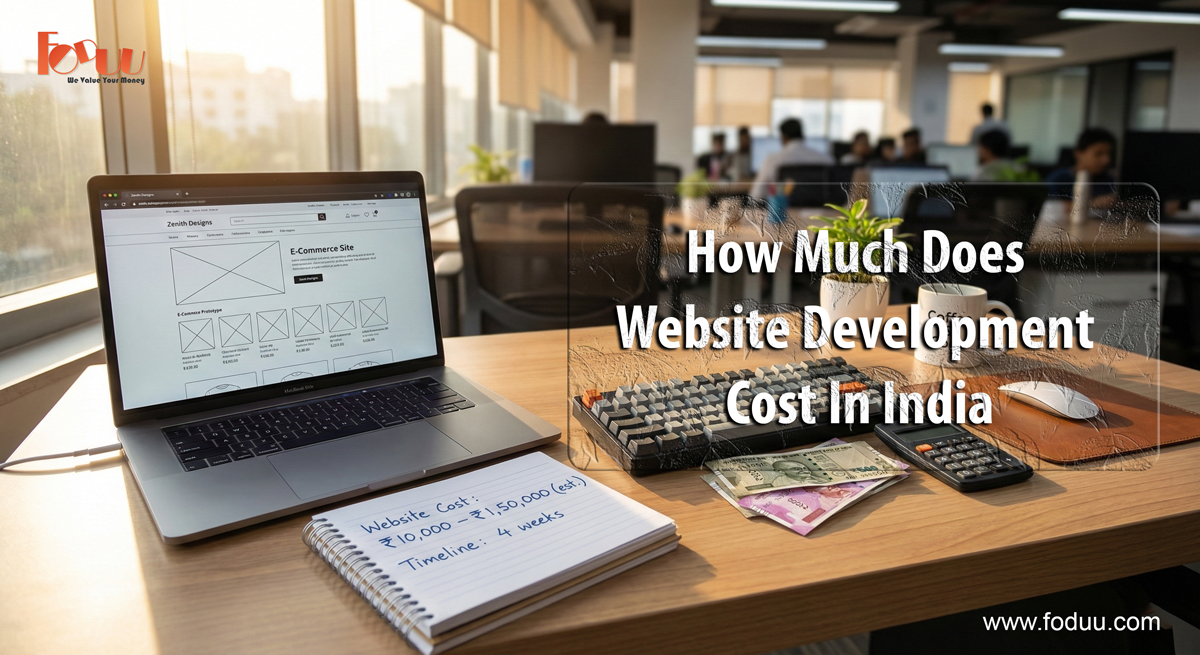

A modern website operates as a business system, and not as a passive online presence, which captures leads, guides user decisions, supports automation, and directly influences revenue. Because of this shift, the website development cost in India is now shaped by a site's outcome such as speed, scalability, conversion, performance, and integration instead of basing the price on design or page count.
Global businesses look to India for web development. The appeal here lies in the performance efficiency of a website. India has a good number of skilled website developers who are capable of building high performing websites at a price that is just a fraction of Western market rates. This evolution has redefined pricing expectations across industries for start-ups and enterprise-based platforms.
So, based on current project scopes and delivery standards, here is a realistic cost of a website development for 2026:
| Website Type | Estimated Price Range (INR) | Ideal Use Case |
|---|---|---|
| Basic Static Website (5 Pages) | ₹15,000 to ₹30,000 | Personal brands, local services |
| Small Business / Dynamic Website | ₹40,000 to ₹1,20,000 | Start-ups, consultants, SMEs |
| E-commerce Website (Basic) | ₹60,000 to ₹2,50,000 | Online stores, D2C brands |
| Enterprise / Custom Web Application | ₹5,00,000 to ₹25,00,000 | SaaS platforms, marketplaces |
These figures reflect an initial part of the website development process. The final website development price in India depends on how advanced the site's functionality is, how much customization is required, and how strong is the platform for the future.
In this guide, you will see the variables in detail that cover the significance of having a website, a website development's pricing model, technology choice, hidden cost, and smart budgeting decision. The post will help you make investment with clarity rather than you make assumptions.
Website development pricing in 2026 is shaped by engineering depth and strategic intent, not by surface-level design choices. Two websites may appear similar visually, yet differ significantly in cost due to what happens behind the interface logic, automation, scalability, and long-term maintainability.
A website is essential for any business or organization in today's digital age.
It serves as a virtual storefront, providing potential customers or clients with information about your products, services, and brand.
A website allows you to showcase your expertise, build credibility, and connect with your audience on a global scale. With the increasing use of smartphones and tablets, having a mobile-responsive website is crucial to ensure a seamless user experience for your visitors.
In short, a website is a powerful marketing tool that can help you reach your target audience, generate leads, and drive sales or donations.
A website's ability to reach a worldwide audience is one of its strongest arguments. In contrast to conventional physical stores, websites offer a virtual platform for showcasing goods, services, or concepts to a global audience. Through the internet, you can establish connections with people from other cultural backgrounds and broaden your horizons beyond physical boundaries.
Consumers are used to looking up information online before making judgements in the digital age. A well-designed website turns into an online showroom that attracts visitors and increases credibility and trust in addition to grabbing their attention. A professionally designed and aesthetically pleasing website tells prospective clients that your company is trustworthy, serious, and dedicated to providing high-quality services.
The availability of a website 24/7 is one of its main benefits. A website is always open, unlike traditional businesses that have set hours of operation. This accessibility enables prospective clients to browse your products and services, contact you with questions, and even make purchases whenever it's convenient for them. The convenience element takes into account your audience's hectic lifestyles in addition to accommodating different time zones.
Traditional advertising methods can be expensive and may not always yield the desired results. In contrast, maintaining a website is a cost-effective way to market your brand. The integration of social media and strategic search engine optimization (SEO) further amplifies your online presence. Social media platforms become extensions of your website, allowing you to engage with your audience, share updates, and create a dynamic online community.
A website goes beyond being a digital storefront; it serves as a central hub for communication. It provides a platform for customer support, feedback, and interaction. The ability to engage with your audience in real-time fosters a stronger connection. Whether it's addressing inquiries, resolving concerns, or gathering feedback, a website becomes the epicenter of your brand's interaction with its audience.
The pricing of website development is shaped by engineering depth and strategic intent of a platform, and not by surface level design choices. When two websites have the same visuals, yet they will differ in cost. Why? Because of the interface, logic, automation, scalability, and long-term maintainability. Here are the critical factors that define web development cost:
Artificial intelligence (AI) has become a practical component in the development of modern websites. AI is not an experimental add on, but essential in today's digitally advanced landscape. The AI features such as chatbots, recommendation engines, automated content workflows, and predictive user behaviour tracking increase both the development effort and infrastructure need of a website. By integrating AI, the price of a web development project can be between ₹30,000 to ₹2,00,000 or even more, especially when custom training, analytics, or third-party APIs are involved.
The technology used to build a website has a direct impact on its cost, performance, and scalability.
For instance, content driven or small business websites use traditional stacks such as PHP, Laravel, WordPress. While Modern JavaScript stacks such as MERN/MEAN require experienced developers and so increases costs. The plus point is that modern platforms offer better scalability and performance.
With respect to low code or no code platforms, then they initially have a low cost, but at a later point they introduce long term limitations and licensing expenses. On the basis of this development when a site has a more flexible and future-ready stack, the higher will be the upfront investment.
Design costs of a website development also varies widely depending on the execution quality. If template designs are used, then it is a faster and cheaper option, but it has limit differentiation. In comparison to the template-based platform, then a conversion focused custom UX design significantly improves engagement and conversions, but it involves user research, wireframing, interaction design, and usability testing that each add to the project cost.
Responsive design does not significantly affect pricing. However, Progressive Web Applications (PWAs) introduce offline access, app like performance, push notifications, and enhanced speed that adds to the cost. Such features require additional development and testing, which makes PWAs a premium upgrade rather than a default inclusion.
On combining these factors, then website development charges in India vary even though projects that seem similar at first glance.
Website development costs become clearer when they are examined by use case rather than theory. The following category stated below reflects how businesses in India typically build websites, and what are the expectations that come with them.
Small Business Websites & Professional Blogs
This kind of website development category includes company websites, consultant profiles, service providers, and content focused blogs. Most projects in this range are built on WordPress and paired with visual builders like Elementor, which allows faster deployment and easier updates on a site.
Some typical inclusions part of such web development work is:
The estimated cost of this kind of website development is between ₹40,000 to ₹1,20,000.
Online selling has evolved and matured significantly, which makes ecommerce website development more complex than building a product listings platform.
Now, modern stores support payments, logistics, analytics, and marketing tools seamlessly. So, for such platform-based solutions, the price of web development is:
₹75,000 to ₹2,00,000 for Shopify or WooCommerce. These are suitable for small to mid-sized online stores that have standard workflows.
For the advanced or custom solutions, the price is ₹5,00,000 for Magento or headless commerce setups.
These sites are designed for building large catalogues, handle high traffic, and have a custom checkout logic. A major cost factor in developing such an omnichannel integration is when inventory and orders sync just like marketplaces and social commerce channels. However, the development raises the effort and cost altogether.
When custom web applications go beyond content or commerce, then these projects are built around functionality instead of pages. The examples here include dashboards, booking systems, SaaS products, and internal enterprise tools.
The cost that derives these elements include:
Such projects are rarely billed as a single fixed amount. So, the estimated development cost to build them is ₹5,00,000 to ₹25,00,000+
Here, developers typically follow a milestone-based pricing, where the development phase include planning, core build, testing, deployment is budgeted separately.
Website development in India is priced using two common models. One is fixed project cost and the other is hourly billing. In this segment, the right choice depends on the clarity and scope stability of a project.
The following are the hourly development rates charged in India by:
Hourly billing works best when requirements change during the development phase, especially when the site is AI driven or integration heavy.
Fixed pricing is suitable for small business sites or standard ecommerce stores, where the site has predictable features and timelines.
The hourly and milestone-based billing is becoming the preferred model in 2026 as AI, automation, and third-party integrations increase scope fluidity,
Launching a website is only the beginning or a part of the web development expenses. The following are the recurring cost that you must be aware of when planning for a web development:
Cloud hosting on platforms like Amazon Web Services or Google Cloud are replacing shared hosting as it offers better speed and reliability, but it comes with a price.
Modern websites require firewalls, regular updates, and vulnerability monitoring unlike SSL certificates that are considered as a basic protection.
The cost of Search visibility depends on continuous content improvements and performance optimization.
Most businesses spend 15 to 20% of the original development cost per year on maintenance, updates, and support.
Third-party tools, paid plugins, extra revisions, and API usage can increase monthly costs.
Businesses gain access to experienced developers, modern tech stacks, and scalable delivery models in India for the purpose of value sourcing, and not for cutting cost in comparison to Western markets. Here's a high-level comparison that is based on the prevailing market rates:
| Region | Small Business Website | Custom Web Application |
|---|---|---|
| United States / United Kingdom | $5,000 to $10,000 | $50,000+ |
| India | $800 to $2,500 | $8,000+ |
The difference in pricing is based on quality alone but operational cost, talent availability, and development efficiency. That is why India is a preferred destination for start-ups and enterprises.
Low pricing of a website development often hides long term problem, which many businesses discover this only after their site is launched. The following are some points that will help you avoid cheap website traps:
Such themes help reduce upfront cost, but they create security risks, update issues, and legal exposure.
They offer low quotes service, but often they miss work deadlines due to handling of multiple work, and have poor documentation presentation, and leave the project eventually.
With cheap builds, a site's future growth is not taken into consideration, which makes upgrades costly at a later period.
If a web development proposal is 50% cheaper than the market price, then such savings are spent later on a site's rework, delay or rebuilding.
There are several modern technologies that can increase the cost of website development because they need more development work and ongoing support. The following are the details that will make you aware how the price range of web development is affected:
requires changes in content structure, navigation, and search setup. It means websites have to work with voice assistants that needs more cost to set it up.
features involve advanced development and strict security checks for adding digital wallets, secure user identities, or block chain functions.
requires building login controls, permissions and security layers.
means to build a website that runs on optimized code and environment friendly hosting, which needs specialized skills to test and maintain them.
Website development cost in India should be viewed as an investment, and not as an expense. If you have a well-built website that delivers performance, scalability, and measurable business results, then isn't it better than having a poorly planned platform that requires repeated fixes and involves long term costs.
So, before you can finalize to work with a developer or agency, then got through this quick checklist before you sign with them:
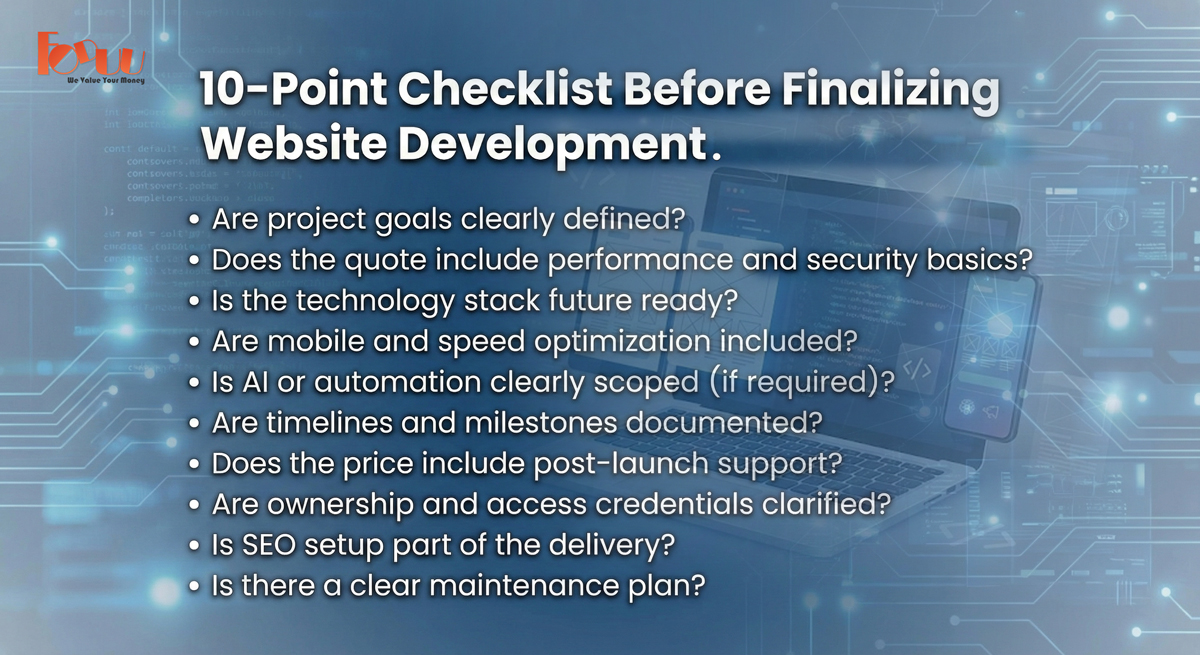
Remember that a clear scope and realistic budget always deliver better outcomes than choosing the lowest quote.
Here are some more frequently asked questions that will help you know more about the web development field:
Question 1) what is the minimum website development cost in India in 2026?
Answer 1) a basic static website can start from ₹15,000, while business ready websites usually begin around ₹40,000.
Question 2) How much does a small business website cost in India?
Answer 2) most small business websites cost between ₹40,000 and ₹1, 20,000, depending on their design, features and customization.
Question 3) How much does an ecommerce website cost in India?
Answer 3) a basic ecommerce website costs ₹60,000 to ₹2, 50,000, while advanced and custom platforms can go much higher.
Question 4) is maintenance cost included in website development charges?
Answer 4) in most cases, maintenance is charged separately, and is typically charged 15 to 20% of the development price per year.
Question 5) which is cheaper? Hiring a freelancer or an agency?
Answer 5) Freelancers usually charge less, but they don't have a better reliability, support, and long-term scalability like the big agencies.
Question 6) Does website pricing in 2026 include Artificial intelligence features (AI)?
Answer 6) Basic websites usually do not include AI. The features like chatbots or automation are added separately that increase the total cost.
Website development cost in India varies because every project has different requirements. Simple websites have basic pages, so they cost less, while feature rich websites have user accounts, integrations, and automation that require more time and expertise.
Here is a simple table that demonstrates separate price for separate platforms:
| Website Type | Typical Cost Range |
|---|---|
| Basic Static Website | Low |
| Small Business Website | Medium |
| E-commerce Website | Medium - High |
| Custom Web Application | High |
Website developer charges vary based on experience, skill set, and engagement model. The following are the website developers cost in India:
If you want a short-term work, then hourly hiring works best. If you need long term development and dedicated teams, then monthly hiring works better.
If you want to choose between a website development company and a freelancer, then it depends on the size of your project, risk involved, and long-term goals.
Freelancers charge less for their service and work well for sm all projects. However, their availability, and long-term support can be limited.
In comparison to freelancers, then agencies charge more, but they have a set structured process, and provide specialists, quality checks, and ongoing support. Agencies are better suited for big businesses who need critical or scalable websites.
Different industries need different types of websites like some of them need extra security, videos, and online payments. This simple view helps you understand why some websites cost more than others, even if they look similar.
| Industry | Estimated Cost Range | Key Requirements |
|---|---|---|
| Healthcare | ₹80,000 to ₹3,00,000+ | Book doctor visits, keep data safe |
| Education & eLearning | ₹60,000 to ₹2,50,000 | Online classes, student logins |
| E-commerce & Retail | ₹75,000 to ₹5,00,000+ | Sell products, accept payments |
| Finance & FinTech | ₹1,50,000 to ₹6,00,000+ | Strong security, safe transactions |
| SaaS & Technology | ₹3,00,000 to ₹25,00,000+ | User accounts, smart features |
Hiring the right web developer will ensure your project’s success. So, what you should do here is by start reviewing their portfolio to understand the quality, style, and diversity of their previous work. Look for projects that are similar to your requirements, and check that if their designs are responsive, fast, and user friendly.
Also ask them important questions such as their development process, timelines, technologies used, and post-launch support. Remember that only a reliable developer will communicate clearly, set realistic expectations, and offer transparent pricing. Their understanding of SEO, performance optimization, and security practices will help you make the right choice.
Hiring Checklist Aspects
|
Aspects |
What to Look For |
|---|---|
|
Portfolio |
Relevant, high-quality past projects |
|
Communication |
Clear, timely, and professional |
|
Technical Skills |
Modern tools, SEO knowledge |
|
Pricing |
Transparent and reasonable |
|
Red Flags |
Vague scope, very low pricing |
If your current site has an outdated design, works slowly, lacks mobile responsiveness, and fails to convert visitors into customers, then you can opt for a website redesign, which is just 30 to 70% of a new build website.
If your website already has strong content, SEO value, or backend systems in place, then redesigning can save your time and budget. However, if a site has major technical limitations, poor architecture, or scalability issues, then investing in a new one is considered good for the long term.
With a redesign, you can gain attention of those users too who did not do business with you earlier. By adding new elements and interactivity features, they would sure like to deal with you.
See this comparison for a better understanding of redesign and development:
|
Factor |
Website Redesign |
New Website Devlopment |
|---|---|---|
|
Cost |
30–70% of new build |
100% (full investment) |
|
Time Required |
Faster |
Longer |
|
Flexibility |
Limited to existing structure |
Fully customizable |
|
Best For |
Improving existing site |
Building from scratch |
|
SEO Impact |
Can retain existing rankings |
Requires fresh SEO setup |
SEO is not something that you will add later, as it will be part of your website right from its development. A properly developed SEO based website will have on-page elements like meta tags, headings, keyword placement, and image optimization.
Things like fast loading speed, mobile responsiveness, clean code, XML sitemap, and schema markup plays a big role in the setting up of a website. This helps search engines to understand and rank your website better.
When SEO is done during a site's development, then you don’t have to spend heavily at a later stage. It already gives your website a strong foundation which helps your site to have visibility.
What’s part of an SEO setup?
|
SEO Component |
Description |
|
On-Page SEO |
Meta tags, headings, keyword optimization |
| Technical SEO |
Site speed, mobile optimization, clean code |
| Schema Markup |
Structured data for better search visibility |
| Core Wb Vitals |
Performance, loading, interactivity metrics |
| XML Sitemap |
Helps search engines crawl your site |
With the rise of no-code platforms, businesses now have more options to build websites quickly and affordably. The benefit of No-code tools is that it allows users to create websites using visual builders without having any technical knowledge. This makes the no-code ideal for start-ups, small businesses, and quick launches. Also, the price is lower, and development time gets significantly reduced.
However, in the case of custom-built websites, then they offer greater flexibility, scalability, and performance as they are tailored to specific business needs, advanced features, integrations, and unique user experiences that no-code platforms may not offer. While the upfront cost of custom development service in India is higher, however it often delivers better long-term value for growing businesses.
|
Factor |
No-Code Website |
Custom Website |
|
Cost |
Low initial cost. |
Higher upfront cost |
|
Development Time |
Very fast |
Moderate to long |
|
Customization |
Limited |
Highly flexible |
|
Scalability |
Restricted |
Highly scalable |
|
Maintenance |
Easy |
Requires developer support |
Website development costs in India depend heavily on the features that is added to a website. As each advanced feature requires additional development time, its technical expertise and testing directly affects the final cost. The following details demonstrate the cost of website development:
| Feature | Estimated Cost (INR) |
|---|---|
| Payment Gateway Integration | ₹10,000 – ₹40,000 |
| Chatbot Integration | ₹15,000 – ₹1,00,000 |
| CRM Integration | ₹20,000 – ₹1,50,000 |
| Custom Admin Dashboard | ₹75,000+ |
| API Integration | ₹15,000 – ₹2,00,000 |
| Speed Optimization | ₹10,000 – ₹50,000 |
With feature-based costs, you can plan your budgets more accurately and select only those functionalities that support your growth. Also, this approach helps prevents overspending on unnecessary features.
Website development is a long-term business investment, and not an expense. It will deliver measurable value beyond just being an online platform. In summary, a website development is worth the investment when it helps with:
Google prioritizes on a website content that drives user outcomes. A website whose sole purpose is on cost then they often struggle to perform in search results and conversions.
When selecting the right website design and development company, then you should evaluate them on the following basis:
A company that follows a structured development process is more likely to deliver scalable, secure, and future-ready websites.
By working with a development partner, your website is impacted with performance, scalability, and ROI. FODUU is a full-service website development company in India brings a proven track record of delivering high quality, business focused web solutions. There are many reasons that why businesses trust FODUU:
This combination ensures that you will receive a website, but a reliable digital asset that is designed for growth, performance, and long-term success.
If you're planning to develop a scalable, feature-rich, and future-ready website, schedule a consultation with our team to define the right tech stack, architecture, and performance strategy for your project.